

Hi all! I know it would have been much more timely to post these during Advent, but maybe I’ll be more on the ball next year (God willing!). Until then, here is Pastor Jed’s lovely series on Advent. He brought us five messages, one for each of the candles (including the Christ candle) in the Advent wreath. Praying you enjoy and maybe even re-listen to them for Advent next year.
INTRODUCTION:
Advent is a Christian tradition of observance, expectation, and hope which is celebrated 4 weeks prior to Christmas. It has been a part of the public worship of many Christian denominations for centuries. “Advent” means “arrival” (Latin) or “coming” and it prompts us to pause each day in December and remember why Jesus came to earth over 2000 years ago.
The observance of Advent dates back to the 4th–5th centuries. Early Advent wasn’t about celebrating the birth of Jesus. In the 5th and 6th centuries, the season focused almost entirely on preparing for Christ’s Second Coming and “final judgment” through a period of prayer and fasting. The season was marked by a penitential attitude, in contrast to contemporary expressions of cheer. Advent’s connection to the Nativity only emerged centuries later during the Middle Ages in Christian communities in Western Europe when varying regional differences converged into a standard tradition, which is more closely linked Advent to the Christmas story. Today, Advent is observed as part of the both the religious and the secular holiday calendar. Modern-day Advent is often celebrated with families in the home or in church (my Catholicism).
Modern day traditions vary by country, but common ways of commemorating Jesus’ birth are through Advent calendars (often mass-marketed), wreaths, and candles. Today, the advent wreath and candles provide beautiful symbolism for each week of advent as we wait for Christmas to arrive.
The Advent Wreath first appeared in Germany in 1839. A Lutheran minister working at a mission for children created a wreath out of the wheel of a cart. Later it evolved into a wreath of evergreens symbolizing everlasting life in the midst of winter and death as the evergreen is continuously green. Evergreens also symbolize eternal life and God’s unending love.
Advent Candles. Each of the four Sundays before Christmas, a new candle is lit; typically three purple and one rose (though colors may vary). Each symbolizes a different aspect of Advent; sometimes a fifth white candle, the Christ candle, is added and lit on Christmas Day to celebrate Jesus’ birth. The candles are associated with spiritual virtues like hope, peace, and joy, traditions established by Lutherans in 19th-century Germany. 4 candles = 4 Gospels.
Candles are often nestled in the evergreen wreath. The light of the flickering candle flames reminds us who Jesus is: He came as the Light of the World. John 1:4-5 “In him was life, and that life was the light of all mankind. The light shines in the darkness, and the darkness has not overcome it.” Verse 9 says, “The light that gave true light to the world was coming into the world.”
There is also an element of Advent that is linked to the Second Coming of Christ. Early forms of observance—especially in Gaul and parts of Spain—focused on both the Incarnation (or birth of Christ) and the Second Coming of Christ. It also helps us to give attention, observance, expectation, and hope for His 2nd Coming.
Advent, week one: Hope
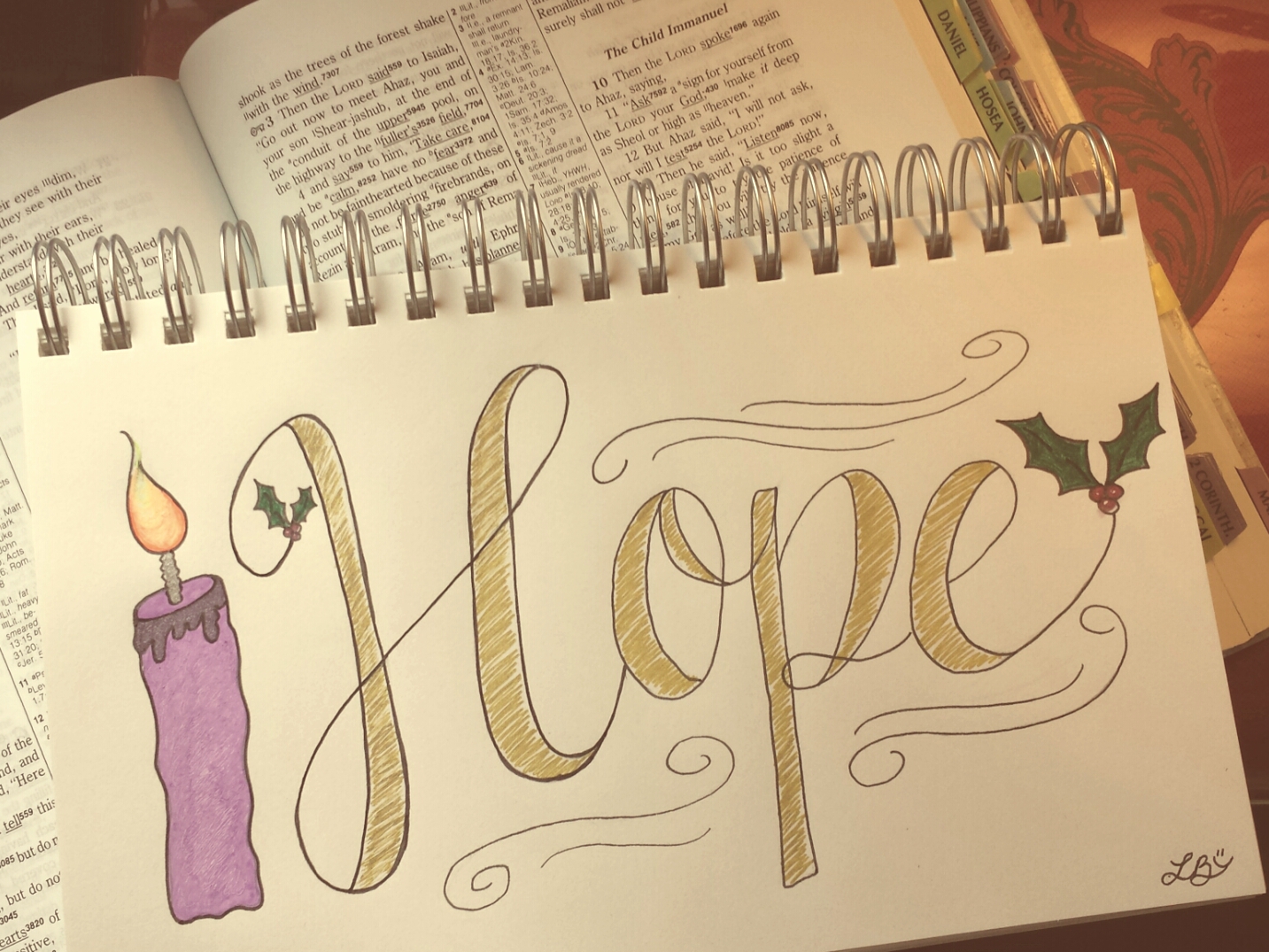
On the first week of Advent, as we light the Hope Candle, also known as the “Prophecy Candle” or the “Prophet’s Candle.” This candle symbolizes the hope and anticipation of the coming Messiah, promised throughout the Old Testament. The Old Testament prophets, especially Isaiah, waited in hope for the Messiah’s arrival. We are reminded to prepare our hearts for the foretold birth of Jesus, and now for the Second Coming of Christ. The purple color symbolizes royalty, repentance, and fasting.
READINGS:
- Genesis 3:14-15
- Isaiah 7:14: “Therefore the Lord himself will give you a sign: The virgin will conceive and give birth to a son and son is given, and the government will be on his shoulders. And he will be called Wonderful Counselor, Mighty God, Everlasting will call him Immanuel.”
- Isaiah 9:2: “The people walking in darkness have seen a great light; on those living in the land of deep darkness a light has dawned.”
- Isaiah 9:6-7: “For to us a child is born, to us a Father, Prince of Peace. Of the greatness of his government and peace there will be no end. He will reign on David’s throne and over his kingdom, establishing and upholding it with justice and righteousness from that time on and forever. The zeal of the Lord Almighty will accomplish this.”
- Isaiah 40:3-5
- John 1:1-18
Advent, week two: Peace
On the 2nd week of Advent, we light (a) the Peace Candle which symbolizes the peace that Jesus brings to our hearts and the world. (b) aka the Bethlehem Candle. Micah 5:2 foretold that the Messiah would be born in Bethlehem (the birthplace of King David). This candle reminds us of the preparations made in Bethlehem for the arrival of the Savior, as well as the humble and quiet circumstances of His birth. The purple candle symbolizes preparation for the coming King.
READINGS:
- Peace is not simply a thing or a state of mind. Peace is a Person. See Judges 6:20-24. Vere 24 – Jehovah Shalom – “I am Your Peace.” He is Peace. He is the God of Peace. (See Romans 15:13, 33; 16:20; II Corinthians 13:11; Philippians 4:9; I Thessalonians 5:23; II Thessalonians 3:16; and Hebrews 13:20).
- He offers us peace by offering HIMSELF in Jesus Christ! (See Isaiah 53:5, Matthew 11:28-30, John 14:27, 16:33). In Isaiah 9:6-7, he is called the Prince of Peace. Know Him (John 17:3), know peace.
- Luke 1:5 - 2:31 tells of the birth of John the Baptist, the birth of Jesus foretold (the “Annunciation” to Mary), Mary visits Elizabeth, Mary’s song, the birth of John the Baptist, and the birth of Jesus. Luke 2:1-20 – “Peace on earth to men!” This was the angels’ announcement that the PERSON of peace had come to earth.
- In Christ, we have:
- Romans 5:1 – “We have peace with God through our Lord Jesus Christ.”
- Ephesians 2:14-15, 17 – He has bought peace between us as people. “For he himself is our peace, who has made the two groups one and has destroyed the barrier, the dividing wall of hostility.”
- Peace of heart and mind (Philippians 4:6-7, Colossians 3:15) and peace in the body (Proverbs 14:30)
Advent, week three: Joy
Today we light the Joy Candle (aka the Shepherd’s Candle) which reminds us of the joy that filled the shepherds’ hearts when the angels announced Jesus’s birth, declaring “good news of great joy for all people.” This candle is often pink or rose which signifies joy. The shift from purple to a pink candler symbolizes a shift from the somberness of repentance to the joyfulness and rejoicing of the coming Savior.
The world’s definition of “Joy” is (1) an emotion or feeling of great happiness or pleasure (delight) or a state of great happiness, euphoria, or bliss. (b) the expression or exhibition of this emotion/feeling.
True Joy is a quality of the character of God. It is a part of Who He is – He is Joy! True joy comes from God to us. Jesus was often joyful (Luke 10:21) and Joy motivated Jesus to endure the cross (Hebrews 12:1-2).
John 15:9-11. The Lord freely offers us His joy. See Psalm 94:19, 16:7-11.
Biblical Joy goes deeper than and transcends happiness or other feelings which are rooted in external circumstances. Joy is a deeper sense of pleasure, contentment, fulfillment, and peace that is rooted in our relationship with God and in knowing God (John 17:3). It is based on Who Jesus is rather than who we are or what is happening around us.
Joy is a “fruit” of the spirit by the Holy Spirit in our lives (Galatians 5:22). It comes by abiding in the presence of God (Psalm 16: 11), hoping in His Word, and is sustained by trust in God’s promises and the work that He accomplishes in us. Joy involves a choice to respond to life’s challenges with this “force” of joy within us which is greater than the world and its circumstances. See Habakkuk 3:17-18, I Peter 1:8, James 1:2-3. “The joy of the Lord is your strength.” Nehemiah 8:10
Final Blessing: Psalm 30:11-12 and Romans 15:13
Advent, week four: Love
John 3:16-17. God’s motivation for our salvation and redemption is His LOVE. See also Romans 5:8.
On the fourth week of Advent, we light the Love Candle. Christmas is ultimately a celebration of God’s love for each of us which God demonstrated in sending His Son to the world to accomplish the work of redemption and salvation. Advent is a time to reflect on and be grateful for His great, unconditional, and sacrificial love.
The scriptures teach us that God is Spirit (John 4:24), God is Life (John 14:6, 17:3, I John 5:11), God is Light (I John 1:5), and God is Love (I John 4:8, 16). We have His love because He Who is Love has given Himself to us.
The book of Psalms repeatedly describes God’s love as great, unfailing, wonderful, priceless, better than life, enduring (endures forever), everlasting, often coupled with faithfulness. Psalm 103: 11-13; Psalm 136.
4 Types of Love: Eros, Storge, Phileo, and Agape (which is God’s love)
We as Christians are called to (a) Love God. Matthew 22:37–38 and (b) Love others. Matthew 22:39 and John 13:34.
What does love “look” like? Love is described in I Corinthians 13 and summed up in the Person of our Lord Jesus Christ. Verse 13 “And now these three remain: faith, hope and love. But the greatest of these is love.”
1 John 4:19 “We love because he first loved us.” Love is more than a feeling. It is an action word: Ephesians 5:25 – “Husbands, Love your wives.” Love your children. Love your family. Love your neighbor. Love the people in the world.
Romans 5:5 – “And hope does not put us to shame, because God’s love has been poured out into our hearts through the Holy Spirit, who has been given to us.”
Blessing: Lamentations 3: 19-23
Advent, week five: Jesus Christ, the Glory of the Lord
Through Advent, we lit four candles which represent the Hope, Peace, Joy, and Love of Christmas. On Christmas Eve (traditionally Christmas), we lit the Christ Candle, the 5th candle which is typically white and sits in the center of the Advent wreath. This candle represents Jesus Christ, the Light of the World, whose birth we celebrate on Christmas. It also represents His Light and Purity. The Christ Candle reminds us that all the hope, peace, joy, and love symbolized by the other Advent candles are embodied in and find their fulfillment in Jesus Christ.
Who is Jesus Christ?
John 1:1-5 – He WAS God, was present at the time of creation (see Colossians 1:16, and He was life and light and offered His life and light to us.
John 1:14, 18 – When He became incarnate, He became the Son of God and the Son of Man.
A name is often given to express who that person is and what that person does. (a) “Jesus” – Greek form of the Hebrew name Joshua meaning “Jehovah Saves” or “Jehovah is Salvation” (Matthew 1:21). (b) The Messiah (Hebrew) and the Christ (Greek) which mean “Anointed One.” (c) Immanuel which means “God with us.”
I John 4:17 – “in this world we are like Him.” He is often pictured as He WAS in the Gospels. We need to be more concerned with Who He IS…NOW!
Other scriptures that describe Who He IS: Ephesians 1: 10, 17-22; Ephesians 4:14-19; Philippians 2:5-11; and Colossians 1:15-20, 2:2-3, 2:9-10, 3:1-4. Notice how often the word “fullness” is used.
 Colona Community Church